

High performance industrial door systems are a critical part of modern factory automation. In automated manufacturing environments, every second matters. Traffic flow must be fast, safe, controlled, and reliable. This is why industrial doors are no longer treated as simple building components. They are now essential elements of production efficiency, energy management, environmental control, and workplace safety.
For factories, warehouses, processing plants, logistics hubs, and automated production facilities, the right door system can improve throughput, reduce downtime, support climate control, and protect sensitive operations from dust, noise, and contamination. As automation continues to expand across industries, demand for industrial door systems with higher speed, stronger durability, smarter controls, and lower maintenance has increased significantly.
This page provides a complete SEO-friendly overview of high performance industrial door systems for factory automation, including definitions, key applications, advantages, common types, technical specifications, selection criteria, and installation considerations. The content below is written for direct use in a blog post, service page, category page, or industry landing page.
High performance industrial door systems are advanced doors designed for demanding operational environments where frequent opening and closing, rapid movement, thermal separation, safety control, and automation integration are required. Unlike standard commercial doors, these systems are built for heavy-duty use and engineered to support continuous industrial workflows.
In factory automation settings, these doors often connect with sensors, conveyors, forklifts, automated guided vehicles (AGVs), robotics, control systems, clean zones, cold storage areas, and production lines. Their main purpose is to create an efficient transition between spaces while minimizing energy loss, protecting products, and improving workflow.
Typical characteristics of high performance industrial door systems include:
Factory automation depends on smooth movement and controlled access. A production line may involve hundreds or thousands of door cycles per day. If a door is slow, unreliable, or unsafe, it can create bottlenecks, increase energy costs, and reduce overall productivity. That is why industrial door systems play a strategic role in automated facilities.
In many operations, the door becomes a control point for:
When integrated properly, an industrial door can operate automatically in response to traffic detection, access control signals, production logic, or environmental conditions. This makes it an essential component of smart manufacturing and Industry 4.0 environments.
High performance industrial door systems provide a wide range of operational benefits for factories and automation-driven facilities. These advantages are one of the reasons they are widely used in modern industrial architecture and plant engineering.
| Benefit | Description | Operational Value |
|---|---|---|
| Faster workflow | Rapid opening and closing reduces waiting time for workers, vehicles, and machines. | Improves productivity and throughput. |
| Energy efficiency | Shorter open times help maintain indoor temperatures and reduce air loss. | Lowers heating and cooling costs. |
| Safety improvement | Sensors, interlocks, and automation reduce collision and injury risks. | Supports a safer work environment. |
| Environmental control | Sealing and insulated designs protect against dust, moisture, noise, and contaminants. | Preserves product quality and process conditions. |
| Reduced downtime | Durable components and smart diagnostics limit breakdowns and service interruptions. | Supports uninterrupted operations. |
| Automation compatibility | Can be linked with sensors, PLC systems, conveyors, and access control systems. | Enables smarter and more efficient plant operation. |
There are several types of industrial door systems used in factory automation. The right choice depends on traffic frequency, opening size, environmental conditions, and performance requirements.
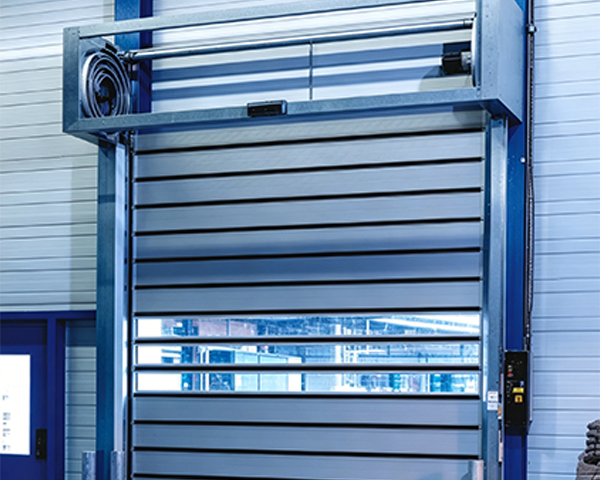
High-speed roll-up doors are among the most popular choices for factories. They open and close very quickly, helping reduce air exchange and improving traffic efficiency. Their compact design makes them suitable for internal and external industrial openings.
Typical uses: internal production zones, logistics passages, clean areas, and temperature-controlled spaces.
Sectional industrial doors are made of horizontal panels that move upward and overhead when opened. They are known for strong insulation, good sealing, and space-saving operation. They are often used where thermal control and durability are important.
Typical uses: loading bays, warehouse entrances, production building access points, and service areas.
Rapid PVC doors are lightweight, flexible, and fast-moving. They are commonly used in areas that need frequent access with minimal downtime. Their simple structure can support smooth automation and fast cycle times.
Typical uses: internal factory divisions, packaging lines, food production zones, and clean workflow areas.
Sliding industrial doors move horizontally and are often chosen for very large openings or heavy-duty applications. They can be manually operated or automated depending on the facility’s requirements.
Typical uses: oversized machinery access, large plant openings, and specialized production environments.
Fire-rated industrial doors are designed to help contain fire and smoke in emergency situations. In factory automation, they may be integrated with alarm systems and safety controls to close automatically when needed.
Typical uses: fire separation zones, hazardous areas, and compliance-sensitive industrial facilities.
Insulated industrial doors are designed to reduce thermal transfer. These doors are especially useful in facilities where temperature stability is critical, such as food processing, cold storage, and pharmaceutical manufacturing.
Typical uses: chilled rooms, frozen storage, thermal segregation points, and energy-sensitive areas.
When evaluating industrial door systems for factory automation, it is important to understand the features that make them suitable for automated environments. High performance is not only about speed. It also involves reliability, control, safety, and lifecycle value.
| Feature | Purpose | Why It Matters |
|---|---|---|
| High opening speed | Reduces waiting time and air exchange. | Improves efficiency and environmental control. |
| Automatic sensors | Detect movement, vehicles, or proximity. | Supports hands-free operation. |
| Safety photocells | Prevent closing when an object or person is in the path. | Reduces accidents and equipment damage. |
| PLC compatibility | Allows integration with industrial control systems. | Enables process automation and monitoring. |
| Emergency manual override | Allows operation during power loss or system failure. | Improves reliability and business continuity. |
| Wear-resistant components | Extend service life under high-cycle use. | Reduces maintenance frequency. |
| Sealed perimeter design | Limits dust, airflow, moisture, and noise transfer. | Protects product quality and working conditions. |
High performance industrial doors are used in a broad range of automation-driven industries. Their flexibility makes them suitable for many operational settings where fast access and controlled separation are required.
Factory automation is built around reducing waste, shortening process time, and maximizing output. Industrial door systems contribute to these goals in several ways. By opening quickly and closing reliably, they reduce unnecessary pauses in material transfer. By sealing properly, they help maintain the required conditions for production. By integrating with automation systems, they respond intelligently to traffic and process signals.
Productivity gains may come from:
In a high-volume facility, even a few seconds saved per door cycle can lead to significant annual gains. This is why many industrial operators treat door performance as part of overall plant efficiency planning.
One of the most important reasons to install high performance industrial door systems is energy management. Every time a door remains open too long, heated or cooled air escapes. This forces HVAC systems to work harder and increases operating costs. In temperature-sensitive factories, this also affects process quality and storage stability.
Energy-efficient industrial doors help by:
For facilities with cold rooms, freezers, or controlled production climates, these benefits can be especially valuable. The right door system can support both sustainability goals and cost reduction targets.
Safety is a major concern in factory automation. Door systems often operate near moving equipment, conveyor traffic, forklifts, pallet trucks, and employees. That makes proper safety design essential.
Common safety elements include:
These safety features help prevent collisions, crush hazards, and unintended closure. They also support compliance with industrial safety standards and internal plant risk management policies.
Modern industrial door systems can be connected to a wide range of automation platforms. This makes them more than mechanical barriers. They become part of the facility’s operational logic.
Examples of integration include:
Integration allows doors to open only when needed, which improves safety, reduces energy loss, and supports higher workflow precision. In advanced factories, door systems can be part of an intelligent production environment where movement is synchronized with machine activity and traffic patterns.
When selecting a high performance industrial door system, it is useful to compare key technical specifications. These values help determine whether a door is suitable for the facility’s operating conditions and usage intensity.
| Specification | Typical Range | Selection Consideration |
|---|---|---|
| Opening speed | 0.5 to 2.5 m/s | Faster speeds are better for high-traffic zones. |
| Closing speed | 0.3 to 1.5 m/s | Should balance speed with safety control. |
| Cycle life | 100,000 to 1,000,000+ cycles | Higher cycle ratings suit intensive automation use. |
| Door material | Steel, aluminum, PVC, composite, insulated panel | Material should match environment and durability needs. |
| Operating temperature | Varies by model and application | Important for cold storage or high-temperature settings. |
| Wind resistance | Low to high depending on design | Critical for exterior industrial entrances. |
| Ingress protection | Application-specific | Needed in dusty, wet, or washdown environments. |
| Automation interface | Relay, sensor, PLC, smart control options | Must match plant automation architecture. |
Choosing the best industrial door system for a factory automation project requires a practical evaluation of operational needs. The ideal door is not always the fastest or the strongest. It is the one that balances speed, safety, durability, and control for the specific environment.
Important factors include:
By reviewing these factors early in the planning process, facility teams can choose a door system that supports long-term performance and operational efficiency.
The construction of an industrial door has a direct impact on performance, lifespan, and suitability for automation. Different materials offer different strengths.
| Material | Main Strength | Common Use |
|---|---|---|
| Steel | High strength and impact resistance | Heavy-duty industrial entrances and security applications |
| Aluminum | Lightweight and corrosion-resistant | High-speed door frames and moderate-duty systems |
| PVC | Flexible, lightweight, and fast-moving | Rapid access zones and internal partitions |
| Insulated panels | Thermal performance and structural strength | Cold storage and energy-sensitive areas |
| Composite materials | Balanced durability and performance | Specialized industrial and environmental applications |
Even high performance industrial door systems require regular inspection and preventive maintenance. In a factory automation setting, a small door problem can affect an entire workflow. Routine care helps extend service life and reduce unexpected breakdowns.
Maintenance tasks may include:
Predictive maintenance is especially useful in automated factories. By tracking door cycles, fault logs, and response times, operators can detect issues early and schedule service before a failure occurs.
The industrial door market continues to evolve in response to automation, sustainability, and smart factory requirements. Several trends are shaping product development and installation practices.
These trends reflect the growing importance of industrial doors as functional elements in automated production ecosystems.
The following keyword phrases are commonly associated with this topic and can help support search visibility when used naturally in page content:
The table below provides a generic example of common industrial door specification categories. It can be used in industry pages, product overview pages, or technical content sections.
| Specification Category | Typical Options | Relevance to Factory Automation |
|---|---|---|
| Door type | Roll-up, sectional, PVC, sliding, fire-rated | Defines speed, insulation, and usage suitability. |
| Automation mode | Manual, semi-automatic, fully automatic | Affects workflow efficiency and labor demand. |
| Control method | Push button, sensor, remote, PLC | Determines integration level with plant systems. |
| Safety system | Photocell, edge sensor, light curtain, stop switch | Supports safe operation in busy environments. |
| Insulation level | Standard, enhanced, high insulation | Important for climate-sensitive facilities. |
| Duty rating | Light, medium, heavy, continuous | Matches expected cycle intensity. |
| Environment rating | Dry, wet, dusty, hygienic, cold storage | Ensures proper performance in specific conditions. |
High performance industrial door systems for factory automation are vital for modern industrial operations. They improve speed, support safety, reduce energy loss, and help maintain controlled production environments. Whether used in manufacturing, logistics, food processing, cold storage, or high-volume automation facilities, the right industrial door system can directly improve operational efficiency and long-term reliability.
When selecting an industrial door solution, it is important to consider traffic flow, environmental conditions, integration needs, safety requirements, and lifecycle performance. A well-chosen door system is more than an access point. It is a strategic component of an automated factory’s productivity, safety, and energy management strategy.
If you are building an industry page, SEO article, category description, or technical content hub, this topic provides strong search potential through keywords such as industrial door systems, factory automation doors, high-speed industrial doors, and automated factory access solutions. By covering definitions, benefits, applications, specifications, and maintenance, your content can deliver both user value and search engine relevance.
Shenyang Manlong Metal Products Co., Ltd.


Copyright © 2026 Shenyang Manlong Metal Products Co., Ltd. Alle Rechte vorbehalten. Anwendungen
Diese Website verwendet Cookies, um sicherzustellen, dass Sie das beste Erlebnis auf unserer Website erhalten.

 English
 Español
 Portugues
 Pусский
 Français
 العربية
 ไทย
ไทย Türk dili
 Tiếng Việt



 Telefon
Kommentar
(0)